Label and research record
PT-141 dosage and timing in the record
The label describes a particular medicine and indication. A number detached from those conditions loses its meaning.
PT-141 dosage for women
The U.S. prescribing information documents bremelanotide 1.75 mg subcutaneously as needed for acquired, generalized HSDD in premenopausal women. It specifies at least 45 minutes before anticipated sexual activity, a maximum of one dose in 24 hours and no more than eight doses per month. Those are label conditions for the approved prescription product. This site offers no personal dose or administration instructions.
The same 1.75 mg figure appears in the RECONNECT trials. Earlier Phase 2 dose-finding tested 0.75, 1.25 and 1.75 mg. A population and a product surround the selected number: postmenopausal women and men have no approved dose under this indication.
Pharmacokinetics
The label’s pharmacokinetic data describe a terminal half-life of approximately 2.7 hours, with a range of 1.9–4.0 h. Median Tmax, the time of the peak blood concentration, is around 0.5–1.0 hour. Volume of distribution is approximately 25.0 L, clearance approximately 6.5 L/hr and serum protein binding approximately 21%.
Metabolism involves hydrolysis of peptide amide bonds and peptidase digestion. The excretion figures are 64.8% renal and 22.8% fecal. Such precision impresses me less once it is asked to predict somebody’s desire. A blood-concentration profile cannot make that forecast.
PT-141 duration
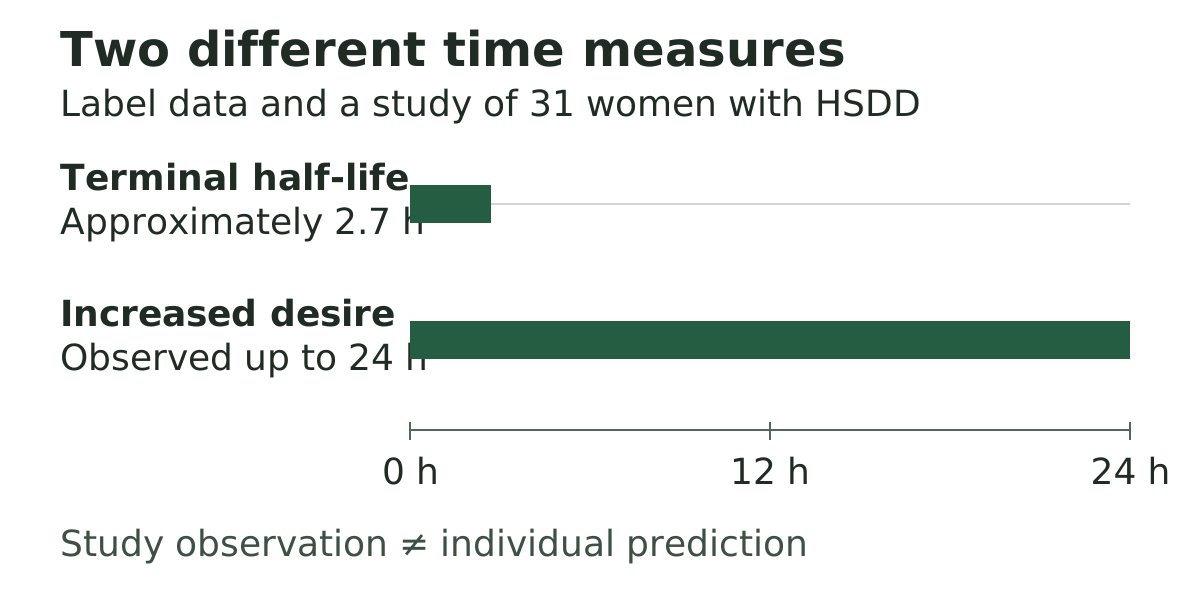
The approximately 2.7-hour terminal half-life concerns the decline in blood concentration. The 31-woman fMRI study observed increased desire for up to 24 hours. These measurements concern different things, in different study settings. Their separation explains why a half-life figure alone leaves the duration question unfinished.
The comparison below shows the difference in time scale. It gives no interval for personal use and no guarantee about onset or duration.
Earlier research routes
The early development profile records intranasal studies. Research in men with ED escalated to roughly 7–20 mg and reported a statistically significant erectile response above 7 mg; early intranasal half-life estimates were 1.85–2.09 h. That route was later discontinued because of pharmacokinetic variability. Intravenous administration also appeared in early pharmacology.
The Phase 1 obesity research used subcutaneous doses up to 2.5 mg, up to three times daily for 15 days in a research protocol. Those investigational conditions establish no weight-loss indication or personal regimen. I see no warrant for carrying historical protocols into a different question about treatment.
Preparation questions
The approved product is supplied as a ready-to-use subcutaneous injection. Research-chemical powders have no pharmaceutical assurance of identity, purity or concentration. Preparation, injection and reconstitution instructions are outside the scope of these essays. A licensed clinician’s assessment is needed for questions about treatment.
The safety page covers the cardiovascular contraindications, pigment changes and tolerability concerns that a dose figure alone leaves out.